Steel on the old control tower at Valley International Airport tells a useful story about this climate. Local reporting says the tower was built more than 50 years ago and that its structural metal is corroding, and the airport broke ground in April 2024 on a new 122 foot tower. Warm humid air, long wet seasons and the occasional tropical storm are hard on structural steel, so the way it is coated, connected and drained matters as much as the way it is lifted.
Structural steel erection is the part of a building where fabricated pieces arrive on trucks and are bolted or welded into a frame. It covers columns, beams, girders, joists and deck, and the connections that tie them to the foundation and to each other. We erect steel for commercial buildings, warehouses, canopies, mezzanines, equipment platforms and the framing of mixed structures where steel meets concrete or masonry.
Sometimes we erect steel that another company fabricated and designed, and sometimes we manage the whole package from detailing to final bolts. Either way, the owner gets one point of responsibility for the frame. For a metal-clad building, compare this page with our notes on clear-span rigid frame buildings.
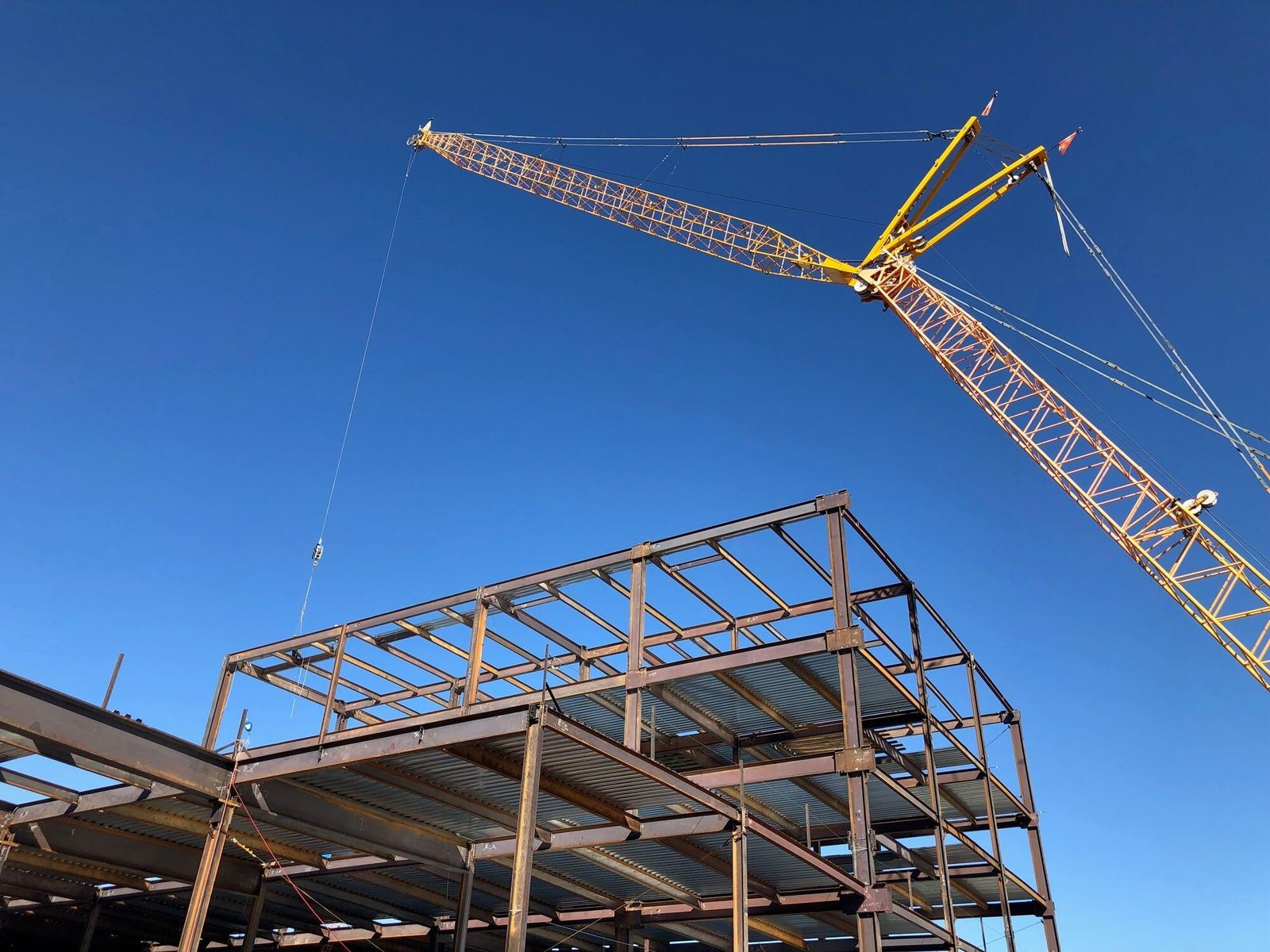
Erection is the riskiest hour of a building's life, and we plan it like it. Before the first piece goes up we walk the site with the crane operator and the steel crew, set the crane pad and swing limits, mark exclusion zones and agree on signals. Every member has a pick weight and a rigging plan, and the bolting and bracing sequence keeps the frame stable at each stage so that no one has to climb an unbraced structure.
Fall protection follows the Occupational Safety and Health Administration rules for steel erection: tie-off points, controlled decking zones, guardrails at perimeters and safety nets or lines where required. We hold a short safety meeting at the start of each day and again when the work changes, and the crane operator, rigger and foreman keep a standing rule that anyone can stop a pick. Weather is a safety issue too, since we stop lifts when wind speeds climb or lightning is within range.
We receive and inspect the fabricator's deliveries, check them against the shop drawings, and lay them out in the order of erection to avoid double handling. We set base plates and anchor rods to survey, plumb and align columns, set beams and joists, install bridging, field-weld or bolt the connections to the engineer's schedule, and place metal deck. The last steps include touching up shop primer, welding shear studs where composite slabs require them and handing over a punch list.
The details at the foundation are where mistakes show up first. Anchor rods have to be placed in the right location and projection, or the columns do not fit. We survey rod locations after the concrete is placed and before the steel arrives, and we tell the fabricator right away if anything is off. For buildings that combine steel with concrete walls, that coordination sits within our tilt-wall work too.
The Texas Department of Insurance puts Harlingen in the Inland II windstorm zone, with a 110 mph three-second gust design speed. A steel frame under construction is at its most exposed before the deck and bracing are complete, so we sequence work to get stability in place early and avoid leaving large areas of open frame during storm season. Temporary guys and cables stay on until the engineer says the permanent system is done.
Corrosion protection is the other local issue. We specify and inspect the paint system, galvanizing where it makes sense, and sealed details at roof penetrations and the base of columns. A steel column sitting in standing water at slab level will rust faster than any coating can handle, so grading and floor drains are part of the steel conversation. We also check that dissimilar metals are isolated in the field, that field welds are cleaned and primed the same day, and that bolts and cut edges receive the same protection as the shop-coated surfaces around them.
Steel is a practical answer for long spans, crane buildings, multi-story structures, mezzanines and any building where the owner wants to change the layout later. It also fits airfield projects, from aircraft hangars to support buildings, as well as commercial and industrial buildings around the airport. The new tower, for example, is an 8,000 square foot building estimated at $2,500,000 with construction listed from May 2024 to January 2027, which shows how long a small public building can take to move from award to occupancy.
We also erect steel for warehouses and plants, where the question is often rigid frame versus bar joist and joist girders. A crane-served building needs heavier columns and crane runway beams set to tight tolerances, while a typical warehouse can use lighter members and wider spacing. We help owners compare these options when they are still choosing.
Steel prices change, and so do fabricator backlogs, so it is wise to confirm both before locking a schedule. The tonnage is only part of the cost: connections, detailing complexity, shop paint, galvanizing, freight and crane time all add to it. Simpler buildings with repeated bays and standard connections cost less to fabricate and less to erect, and a few hours spent simplifying the framing plan in design can save weeks in the field.
We recommend asking the fabricator for a lead time in writing and building a schedule that starts erection after foundations cure and anchor rods are checked. Through our long-lead procurement process we follow each steel order from release for fabrication to delivery, and we tell you early when a delivery date is slipping and whose it is to fix.
Send us the drawings or a sketch, and we will tell you what crane, crew and schedule your frame needs. We can start with a quote for the erection alone or the whole building. Public owners can read about our government work as well.
Yes. We can erect steel from your fabricator or from one we recommend. We check the delivery against the shop drawings, so differences are found on the ground and not in the air.
A mid-size commercial or industrial building often takes a few weeks for the primary frame after foundations are ready, but the right answer depends on the tonnage, the crane access and the weather. We give a day-by-day sequence before work starts.
The design gust of 110 mph in Harlingen is for the completed building. During erection we use temporary bracing designed for the loads that the partial frame will actually see, and we do not leave unsupported areas overnight when a storm is forecast.
By specifying the right coating system, keeping water away from column bases, sealing penetrations and inspecting after installation. In a humid coastal-influenced area, small details decide how long the paint lasts.
Yes, if the sequence is planned. Foundations, anchor rods, slabs and masonry all have to be finished before steel can proceed, and we keep one master schedule so each trade has what it needs.