
The old control tower at Valley International Airport was built more than 50 years ago, and its structural metal is corroding, which is why a new 122-foot tower is going up on the field. Any contractor who builds on an airport learns quickly that the airfield sets the rules: heights are limited, cranes need clearance, and security and flight operations never stop for construction. A hangar is the building type where those rules show up most clearly.
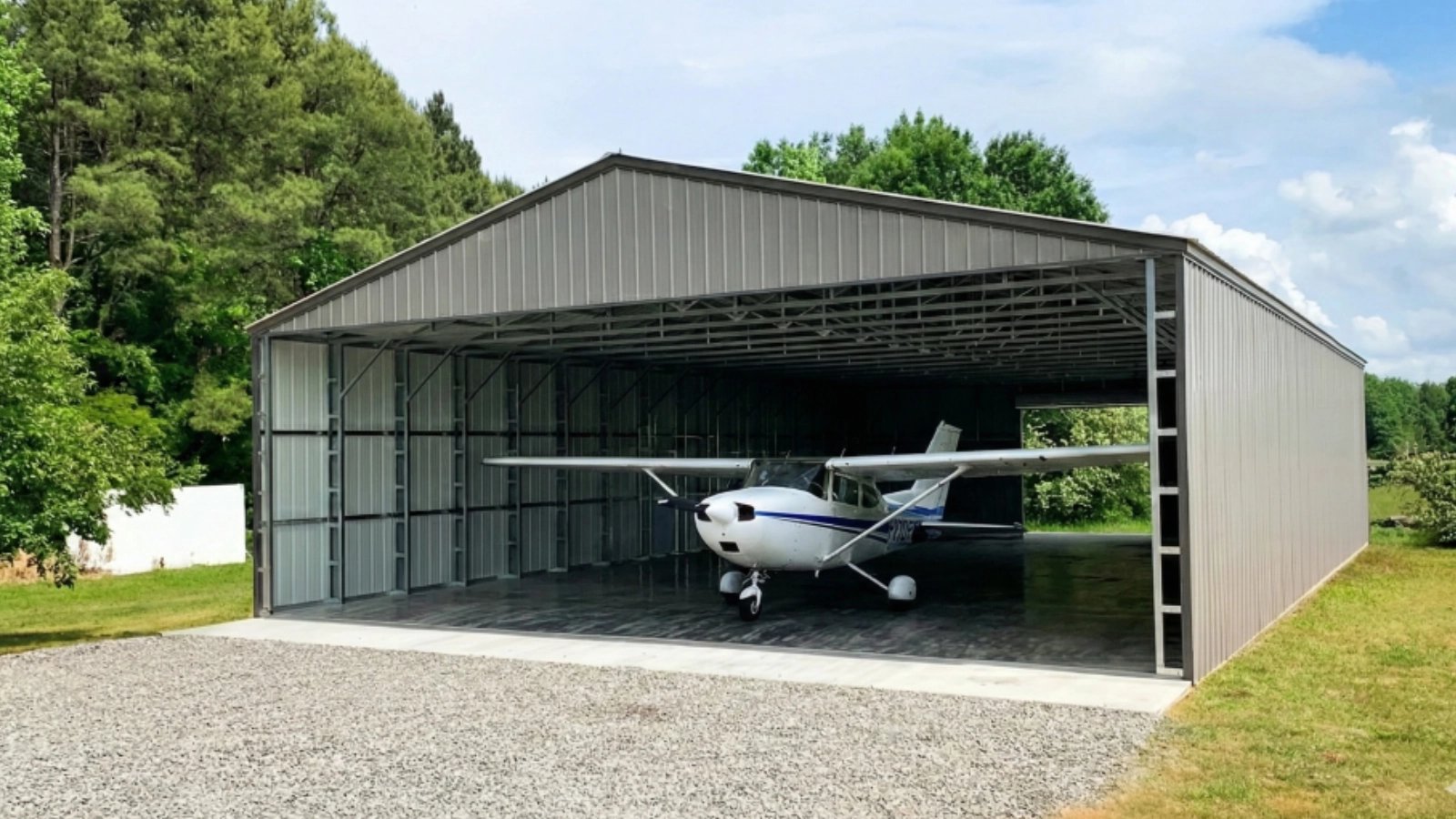
We build aircraft hangars for private owners, flight operators, maintenance shops and businesses that keep a plane for work. A hangar is a very wide clear-span box with a huge door, and every part of it is engineered around the span, the door and the wind. Floors have to carry aircraft, and the fire protection is a specialty system.
This page explains how we approach a hangar at Valley International and at smaller airports nearby. For shops and storage near the field that are not hangars, see warehouses, and for the structural basis see pre-engineered metal buildings.
Before we draw a hangar, we talk to the airport. Lease terms, setbacks from taxiways and the Federal Aviation Administration review of building height and location come first. A crane that lifts steel or panels may need its own airspace review. Hangars are often built on leased ground, which means the lease and the design approvals go together.
Security is the other early issue. A hangar site inside the airfield fence means badging and escort for every crew and delivery truck on our site. We give the airport a list of workers and equipment and arrange deliveries through the right gate. Scheduling construction around flight operations is routine, and we avoid work near active taxiways at times the airport restricts.
Valley International's runway 35L was extended from 8,400 to 9,400 feet between December 2022 and July 2024, at an estimated $35 million, funded 80 percent by the Airport Improvement Program and 20 percent by passenger facility charges. Cameron County's economic development page lists it as the longest of the county's three airports, ahead of Brownsville/South Padre Island International at 7,399 feet and Cameron County General Aviation Airport at 8,001 feet.
The Texas Department of Licensing and Regulation lists the air traffic control tower at 3110 Heritage Way as an 8,000 square foot new building estimated at $2,500,000, with construction from May 2024 to January 2027. Airport investment of that kind brings cargo, charter and general aviation operators, and each wants hangar and shop space. Land next to the field falls within our Valley International Airport market area.
The structure is typically a pre-engineered or steel clear-span building, 60 to 120 feet or more across, with no interior columns. The frame has to support a large door opening along the full width of one wall, so the end frame is a special design. We coordinate frame, door manufacturer and foundations so the door track, header and wind loads work together.
Hangar doors are bifold, hydraulic or sliding. Each style has a different cost, speed and wind rating, and the choice affects the foundation at the door sill. The floor is a heavy-duty slab with a hard finish that resists oil and fuel, slopes gently to trench drains and carries aircraft wheel loads. Our clear-span rigid frame buildings work covers the structural side.
A hangar goes up quickly once the slab is in, but the early phases take time. Airport approval, geotechnical work and the door and frame orders come first. Drainage on an airfield is also regulated, and storm design has to avoid creating standing water that attracts birds.
Rain adds risk: the National Weather Service recorded nearly 19 inches in the heaviest-hit part of Harlingen in March 2025. We schedule earthwork and slab pours for dry periods, and we bring in stabilized access for trucks and cranes. For owners who want a shell first and fit-out later, we use the design and build method to compress the early steps.
Harlingen is in the Inland II zone at 110 mph per the Texas Department of Insurance, and a hangar with a giant door is the wind-sensitive building type. A door that fails in a gale can damage the frame and the aircraft inside. The city's 2024 International Building Code and 2023 National Electrical Code, effective October 1, 2025, apply to buildings inside the city, with the building inspections department handling permits.
Fire protection in a hangar uses foam or specialty sprinkler systems, as well as smoke detection and fire walls between bays, depending on aircraft size and use. Fuel and hazardous materials storage add to the review. We involve the fire marshal and the insurer early, since their requirements can change the size of the water supply and the equipment room.
The cost of a hangar depends on span, door type, floor and fire protection more than on square footage. A bigger door and a longer span add steel and a more complex foundation. Doors can be a significant share of the shell cost. Office and shop space inside the hangar adds heating, plumbing and cooling.
Owners can control cost by sizing the hangar to the aircraft they have plus a modest margin, choosing the simplest door that meets wind and operation needs and building a shell with space to expand. Public owners in the government and public sector, such as airport authorities, add compliance requirements that we handle in the scope.
Send us the aircraft you plan to house, the airport and any lease terms. We will explain what approvals, structure and fire protection the hangar needs, and give a straight first number.
The airport sponsor controls leases and design approvals, and the Federal Aviation Administration reviews height and location. We start with the airport, then submit to the city or county for building permits.
Bifold, hydraulic and sliding doors all work. The choice depends on span, speed, maintenance and wind rating. In the Inland II wind zone, a door with a proper wind rating is essential.
It depends on the aircraft, the use and the insurer. A small private hangar may need standard sprinklers, and a larger or maintenance hangar may need foam or other systems. We confirm before pricing.
Yes, with airport coordination. We use badges, escort, barricades and set work windows to keep flight operations safe.
Wide enough for your largest aircraft plus working clearance. Many owners add room for a second aircraft or a tow tug, which is cheaper to include now than later.