
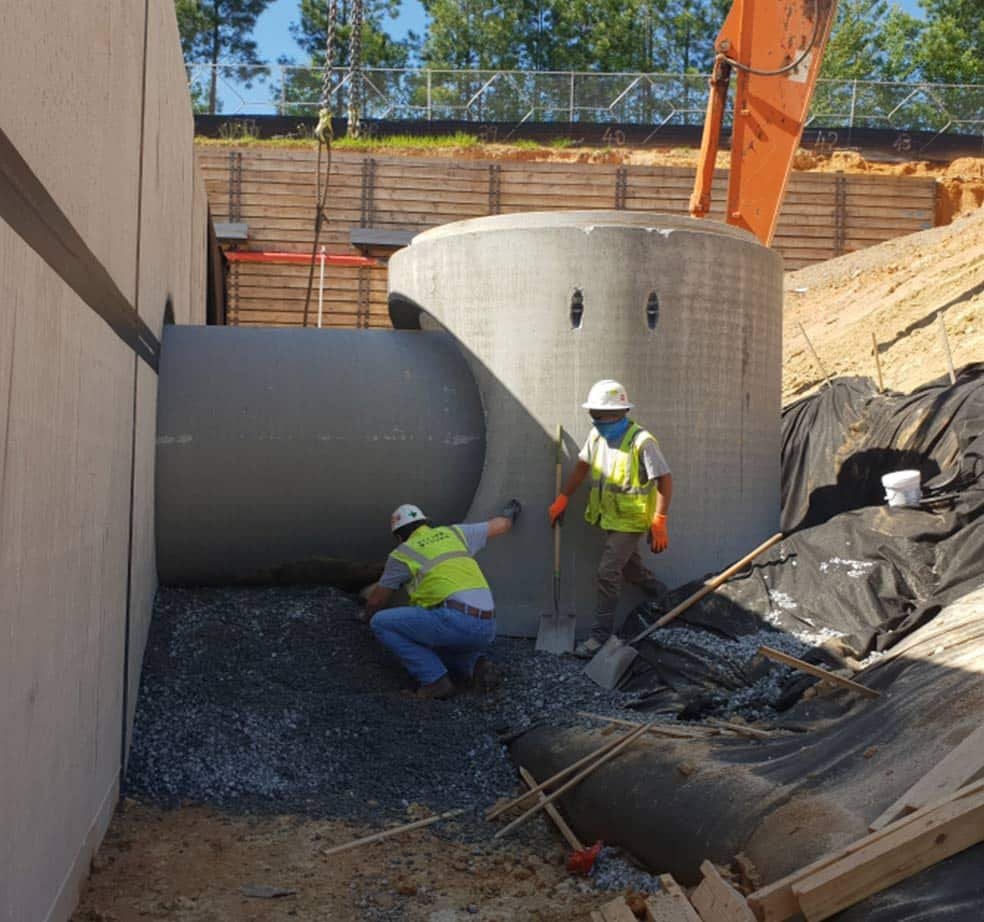
A lake in Combes that looks like an amenity is actually a retention pond owned by Cameron County Drainage District 5. The Crosswind Landing mixed-use plan reported in 2022 puts retail, a wellness center, duplexes and a future hotel around it. That sentence explains most of what site development means in the Valley: water is not a nuisance to be handled at the end, it is the organizing feature of the site.
Site development is everything that has to happen before a building can stand and after it is finished: clearing, grading, fill, drainage, detention, water and sewer service, electrical and gas connections, paving, curbs, striping and landscaping. On a flat, clay-soil, rain-heavy site like Harlingen's, the order and the details matter. We manage the earthwork and flatwork closely, and we manage the utility trades.
The work can be a stand-alone contract, for example when a developer is preparing pads for later sale, or part of a building project. Our notes on stormwater and drainage and mass grading go deeper into those two parts, and parking lot construction covers the paving.
The Harlingen area is nearly flat, and water leaves slowly. The USDA describes the local soil as having very slow permeability, so rain that does not run off stays on the surface. The National Weather Service reported 9.7 to 12.4 inches at Harlingen-area gauges during Hurricane Hanna in July 2020. The city has since begun $700,000 of drainage improvements in three neighborhoods, with larger storm pipes capturing runoff from 105 acres and four to six months of construction per site.
New development must not make this worse for its neighbors. That is why we plan detention before we plan the building, and why the pond often takes more land than owners expect. A detention basin is sized by the engineer based on the lot's runoff, then built with side slopes that can be mowed, an outlet that discharges at an approved rate and maintenance access. We confirm the discharge point and the owner's maintenance duty with the city or the drainage district before the design is final.
Inside city limits, Harlingen administers permits. In unincorporated Cameron County, the county's flood damage prevention order applies, naming the County Engineer as Floodplain Administrator, and requires the lowest finished floor in a flood-prone area to be 12 inches above Base Flood Elevation or 24 inches above the highest adjacent natural grade, whichever is higher. In Hidalgo County, a separate floodplain order requires a development permit with a $50 fee. We determine which rule applies and build the pad to match.
Drainage districts add their own approvals. A development that drains into a district ditch or canal needs the district's consent, and the pipe or outlet design must meet their standards. A $7 million Combes project to widen a pipe under Interstate 69E was reported on hold in May 2025 after a federal grant was frozen, which shows that public drainage upgrades can slip, and private sites should not rely on them being finished on time. We design to what exists today.
The sequence usually begins with a survey, a geotechnical report and a stormwater plan. Then we clear and strip topsoil, install erosion control, rough-grade the site, build the detention basin and set the utilities. Fill is placed in lifts and compacted. In clay soil, lime or cement treatment can stabilize the subgrade, and we use it when the engineer specifies it.
Utilities follow the grading. Water mains, fire hydrants, sanitary sewer and storm sewer are installed and tested, and the service lines are stubbed to each building pad. Electrical and gas are coordinated with the utility companies. Finally come curbs, paving, striping and landscaping. Every step is inspected, and we keep as-built records of pipe locations and elevations for the owner.
Earthwork depends on dry weather. A wet week can halt work for several more days while the site dries, and clay does not dry quickly. We plan the work in sections so a rain delay on one area does not stop everything, and we protect open excavations and stockpiles.
Utility providers set their own schedules. New electric service, gas and sometimes water extensions can take months, and the work often has to be coordinated with road projects. Harlingen's FM 509 and Loop 499 tax increment zones list road, water, sewer and drainage work, so some sites may benefit from new infrastructure as it is built. We ask the providers for their dates in writing during preconstruction. Our long-lead procurement service tracks them.
We schedule and inspect clearing, excavation, fill, compaction, flatwork and many utility installations. That gives us control over quality and timing, and it lets us respond when conditions change. On a site with soft ground, for example, we can quickly adjust the compaction plan or bring in a different material.
For larger or specialized work, such as deep sewer, boring under a road or large detention structures, we use specialty contractors under our supervision. In every case, we put the pipe elevations, test results and inspection records into a close-out package. Industrial owners, including those in logistics and distribution, often start with this work to prepare an area before committing to a building.
Once the pad is ready, owners usually continue with a building. We build warehouses and other structures on the pads we prepare, and a single contract can cover both. The Harlingen EDC's industrial park near Roosevelt Avenue and Interstate 69E, at about 70 acres, has a planned large detention pond for flood control and roads and utilities as its next step, which is a good example of how a site and its infrastructure are planned together. We cover that area on our Harlingen Industrial Air Park page.
Send the address and what you plan to build. We will review the drainage, soil and utility situation and give you a plain budget for getting the lot ready.
It depends on the lot's existing elevation, the flood elevation rule and the drainage path. We calculate from a survey and tell you the quantity, then compare options such as lowering the pad or importing fill.
Usually yes for commercial sites, unless the city or drainage district allows direct discharge to an existing system with capacity. We check with them at the start.
It varies by distance and depth. A lot next to existing mains costs little, while a lot with no services nearby can cost a lot. We price the extension during preconstruction.
Yes, if the pad location, grades and utility stubs are firm. Many owners start site work early to save schedule.
The city or county inspects utilities and grading at set points, and we schedule them in advance. The geotechnical engineer also tests compaction.