
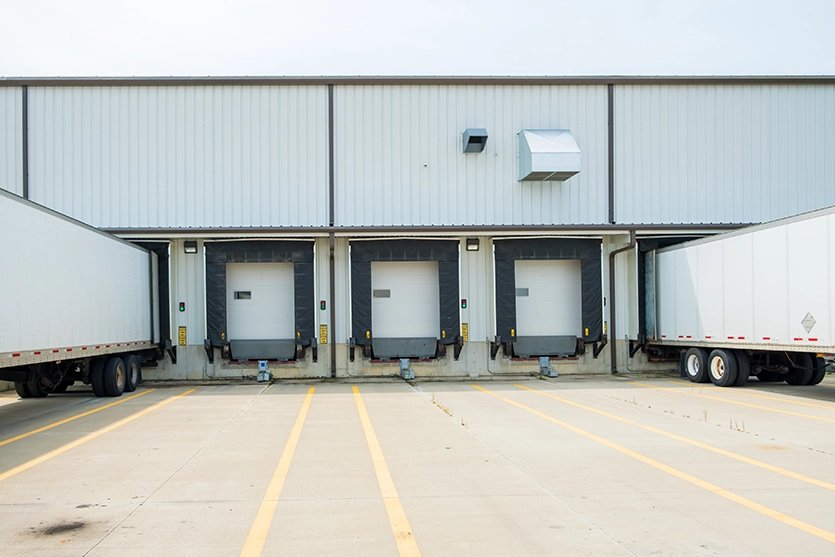
Hale Avenue, Whelen Road, Turner Road, Theme Road and Nixon Road do not sound like freight addresses, but they are on the county's list for reconstruction under the FM 509 tax increment reinvestment zone, along with water, hydrants, sewer and force mains. A truck terminal lives or dies on the roads that reach it, and these streets are being rebuilt in the part of Harlingen that sits closest to the airport and the highway. If you want to put a terminal where trucks can get in and out, that corridor is the place to compare.
A cross-dock or truck terminal is a narrow building with doors on two sides and a lot of concrete around it. Freight comes off one set of trailers, is sorted on the floor and goes onto others without being stored. The building is cheap compared with the paving, and the paving decides whether the terminal works.
This page explains how we plan and build them in the eastern Valley. For storage-heavy buildings see distribution centers, and for the small-parcel sort buildings that feed local deliveries read about logistics and fulfillment centers.
Cross-dock buildings are long and shallow, often 60 to 120 feet deep, with doors on both sides every 12 to 14 feet. The shape lets freight move straight through, and the door count sets throughput. A terminal with 20 doors on a side and a poor court layout handles less freight than a smaller one with a good flow, so we start with the truck movements and work inward.
The interior is a smooth, level, high-traffic slab with little racking. Forklifts, tuggers and conveyors run all day, so the surface needs a hard finish and tight joints. We also include good lighting, dock levelers on the doors that need them and bollards and guards at door frames. Our commercial concrete floors work addresses wear and curling, and we place joints so that wheel paths do not follow them, which is the main cause of chipped edges in a busy terminal.
For a cross-dock the truck court is not an accessory. It usually takes more money than the building. Heavy trailers parked at the dock and turning in the court demand reinforced concrete aprons, properly jointed and dowelled, over a compacted base. Asphalt in the drive lanes is fine where trucks keep moving, but landing gear crushes it where trailers sit.
The trade team for truck courts and dock aprons builds the apron, the dowelled joints, the drainage inlets and the striping. Trailer parking, fuel islands, scales and a small office or driver lounge are added as the owner's operation requires. A guard house and fencing handle access control.
Harlingen sits at the meeting point of U.S. Route 77 and U.S. Route 83, designated Interstate 69E and Interstate 2, and Interstate 69E runs about 53.3 miles from north of Raymondville through Willacy and Cameron counties, according to the state highway designation file. That is the corridor a terminal serves, with trucks moving north and south and from the east-west highway that ends in Harlingen.
Union Pacific keeps a local terminal and switching yard in the city, and Valley International Airport has a 9,400-foot runway that carries cargo aircraft. A cross-dock does not need rail or air to work, but the freight that moves on them often starts or finishes in a truck. We pay close attention to the approach streets, and to the turn from the terminal driveway onto the road. Lots in the Harlingen Industrial Air Park area tend to have the widest frontage, which gives a long driveway room to stack trucks off the public street. Ask us to overlay a turning template on the parcel before you make an offer, because a lot that looks large can still fail on the swing of a 53-foot trailer.
Concrete work on a terminal court is weather dependent. A pour on a wet subgrade fails, and the Valley can get far more rain than owners expect. The National Weather Service recorded nearly 19 inches in the heaviest-hit part of Harlingen in the March 2025 storm. We schedule the base and aprons for dry periods and protect the subgrade between steps.
Drainage design is part of the schedule. The court has to shed water to inlets without ponding at the dock, and the discharge has to meet the city's or drainage district's requirements. We handle that as part of site development and utilities.
Harlingen's building inspections department enforces the 2024 International Building Code and the 2023 National Electrical Code as of October 1, 2025. A terminal's fire requirements depend on what freight passes through it. General freight is one class, hazardous materials another, and some operators handle both. We ask for the commodity list early, since sprinklers, exits and the building's occupancy group follow from it.
Driveway permits on state or farm-to-market roads come from the Texas Department of Transportation, and the review can take months. If the terminal sits on a road under the FM 509 reconstruction plan, the timing of the driveway and the road work should be coordinated. We bring this up in the first meeting.
For a typical terminal, the site and paving cost more than the building. The apron concrete, base preparation, drainage and lighting dominate. Dock equipment, such as levelers, seals and bumpers, adds a significant amount per door. Savings come from using the right number of doors, picking asphalt where it works and avoiding oversized courts.
Phasing is practical here. Build the building at full length but fit levelers only on the doors you use, and pave the court in two stages. We cover how that works in our logistics and distribution work, where operators grow door by door.
Send us peak trucks per hour, the freight classes you handle and the site you are looking at. We will tell you how many doors, how much apron and what budget the building and court require.
It depends on peak trucks per hour and dwell time, not on building size. We work with your operations team to count peak movements and size the door count, and then we leave room to add doors later.
Trailers sit with their landing gear on one spot, and asphalt softens in heat and gets punched through. Concrete holds up and keeps the court level.
Both. A rebuilt road and new utilities help a terminal, but construction can disrupt access for a time. We coordinate with the road schedule.
Almost always, and the design depends on the freight. Tell us what commodities you move and we can find out what the fire code and your insurer will require.