
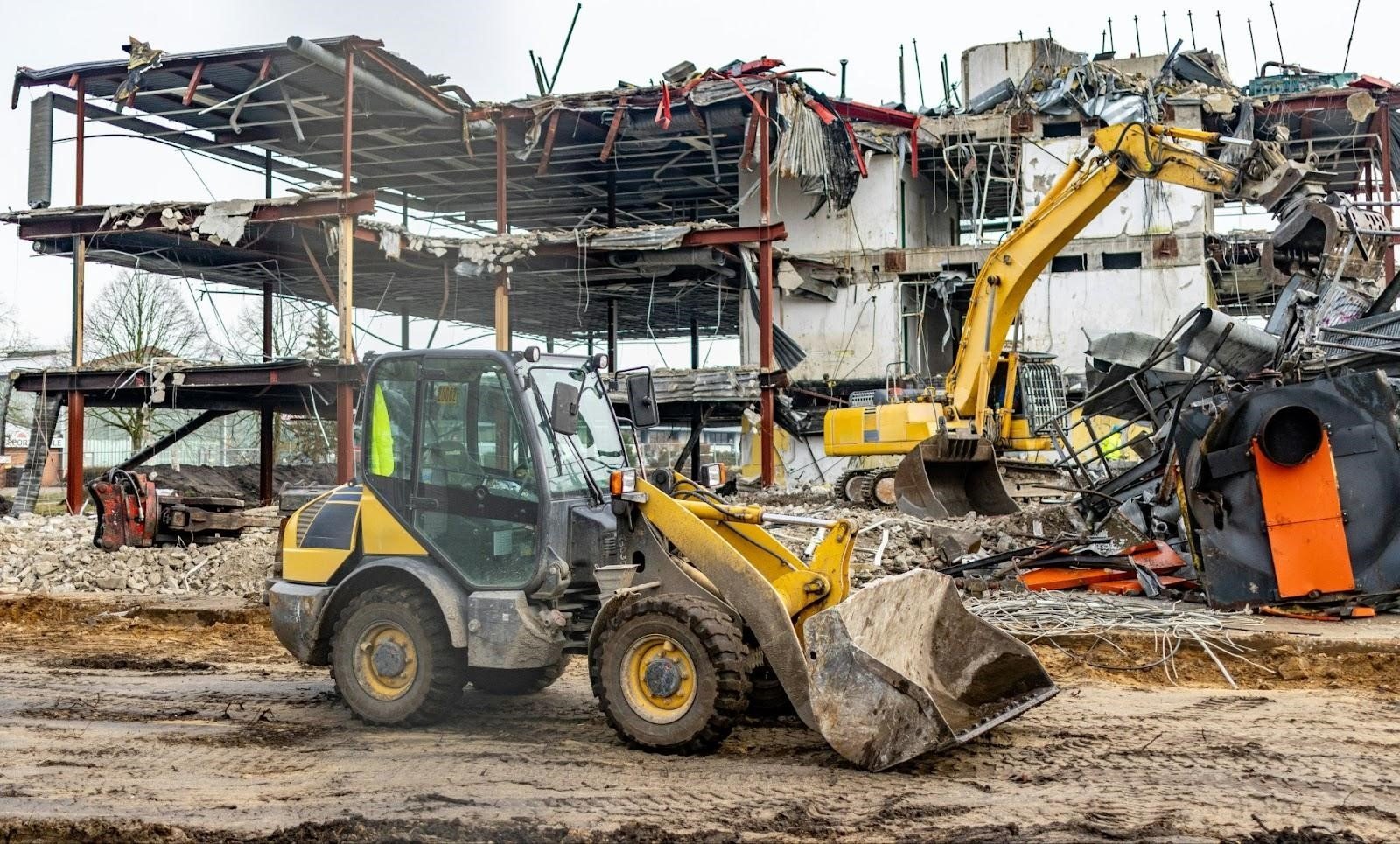
Taking a building down is mostly planning, and the machine work at the end is the short part. Before an excavator touches a wall, someone has to confirm who owns the utilities, find out whether asbestos or lead is present, decide where the debris goes, protect the neighbors and get the permits that let the work start. The owners who have a smooth demolition are almost always the ones who paid attention to that early stretch.
Demolition ranges from selective interior strip-out, where partitions, ceilings and fixtures come out and the structure stays, to full removal of a building, slab and foundation. It also includes site clearing, removal of old pavement, pulling tanks and abandoned utilities, and recycling of concrete and steel. Each type has different risks and a different price.
We handle demolition as a stand-alone package and as the first phase of a larger project. Selective work is closely tied to renovation and adaptive reuse, while full removal usually feeds directly into mass grading for the new building.
Buildings of a certain age can contain asbestos in flooring, mastic, roofing, pipe insulation and wall texture, and lead in old paint. Before any demolition begins, a survey is required, and positive findings are handled by licensed abatement contractors under a plan the owner approves. We do not start demolition until the survey is in hand and, if needed, abatement is complete.
Other hazards include live utilities, structural instability in partly removed buildings, falling debris, dust, noise and vibration. We disconnect and cap electric, gas, water and sewer service ahead of time and obtain written confirmation. Dust control uses water sprays, enclosures and housekeeping. Neighbors are notified, sidewalks and streets are protected, and a competent person inspects the building daily as it comes down.
A demolition permit from the city's Building Inspections Department is required in Harlingen, and the city's building code adoption as of October 1, 2025, including the 2024 International Existing Building Code, shapes what can stay and what must be upgraded in partial demolition. Utility companies require notice and disconnection before work, and state and federal rules call for an asbestos survey and notification before regulated demolition and renovation.
Where flood damage is involved, the rules get tighter. The National Weather Service reported more than 2,000 structures with major damage or destruction in the March 2025 flood across the populated Valley. A damaged building that is repaired may count as a substantial improvement under the county's floodplain order, and one that is torn down and rebuilt will be treated as new construction at the elevation the order requires. We help owners sort out those choices with the floodplain administrator before they commit.
Selective demolition removes only what the new design needs. We protect the structure and finishes that stay, saw-cut openings, remove ceilings and fixtures, cap utilities and haul debris. Precision matters, and a few inches of error at a new opening can cost a day of patching.
Full demolition takes down the structure and often the slab and foundations, then backfills and compacts the ground. Site demolition covers pavement removal, old curbs, underground tanks, sewer lines and septic systems. In a market with many small steel buildings and masonry shops, much of the debris is recyclable: steel goes to a scrap yard, concrete is crushed for base material and clean fill is reused.
We schedule the excavators with demolition attachments, loaders, dump trucks, water trucks and hand crews. Lining them up early keeps scheduling tight, because a job that can start the day after the permit does not wait for someone else's calendar. For tall or complicated structures we bring in a specialty demolition subcontractor and manage the safety program.
Hand work is the other half. Interior strip-out involves dozens of small tasks, from removing light fixtures to cutting pipe to pulling carpet. We separate waste streams on site so that metals, concrete, wood and general debris go to the right places, lowering disposal costs and keeping material out of the landfill. When the cleared ground is destined for a new building, we leave it graded to drain, as described in our notes on stormwater and drainage, and we place erosion controls before the first rain, not after.
The main drivers are building size and type, the presence of hazardous materials, how close the neighbors are, the cost of hauling and disposal, and the market value of recyclable material. A steel building may offset some of its demolition cost with scrap value, while a masonry building with asbestos can cost much more than it looks.
Underground surprises matter too. Old foundations, tanks and utility lines are not always on the drawings. We quote unit prices for hidden items such as additional foundation removal or extra backfill so that the owner has a number ready if something shows up, rather than a negotiation in the middle of the job. Developers clearing an old site for a new center usually ask for a lump sum with those unit prices attached, while public owners tend to want unit-price bidding for the whole scope. We can price either way.
A small building can come down in days, and a larger one in a few weeks, with abatement, permits and utility disconnects taking longer than the demolition itself. We schedule so that demolition ends just before site work begins, since a cleared lot sitting open invites weather and trespassers.
Land preparation often follows right away. The Harlingen Economic Development Corporation's industrial park near Roosevelt Avenue and Interstate 69E, described by a local TV station in March 2026, covers about 70 acres and would start with roads, utilities and a large detention pond, a reminder that clearing and removal come before anything else on a large parcel. Older buildings on the Harlingen Industrial Air Park side of town raise the same question. An aging structure such as the more than 50-year-old control tower at Valley International Airport, whose structural metal the airport said is corroding, shows the point where owners start planning for replacement rather than repair. Our work on older airfield structures such as an aircraft hangar follows the same investigation-first approach.
Send the address, a few photos and any plans you have. We will outline the permits, surveys and costs and give you a range and a schedule.
For commercial buildings, yes. State and federal rules require an inspection before demolition or renovation that disturbs materials, and positive findings require abatement by licensed contractors. We coordinate the survey so it does not hold up the schedule.
A small commercial building may take a week or two once permits and disconnects are done, and larger ones take longer. The preparation phase, including surveys and permits, often takes more time than the teardown itself.
We sort it on site. Metals go to recyclers, clean concrete can be crushed for base, and the remainder is hauled to a licensed disposal facility. Recycling lowers cost and keeps material out of the landfill.
Yes, with careful planning. We install protective barriers, maintain access and exits, control dust and coordinate noisy work. The rest of the building stays safe and usable.
It can. Floodplain rules treat new construction differently from repairs. In unincorporated Cameron County the county order requires a minimum floor elevation, so we recommend confirming with the floodplain administrator before deciding between repair and replacement.